

How would you describe the economic outlook over the next five years in your industry? What do you expect will cause major disruptions in that time? We asked both engineering workers and executives these questions to get a sense for their different perspectives on growth in their industry.
The results show that generally, the engineering sector is hopeful but divided. Growth is widely anticipated, yet executives consistently rate their industries' futures more positively than workers do.
The engineering industry is entering a period marked by optimism, innovation, and transformation. As revealed in the 2025 Kelly® Global Re:work Report, both executives and talent in sectors like Industrial Manufacturing, Robotics, and Semiconductors anticipate robust growth over the next five years.
Yet beneath this confident surface lies a more nuanced story: while leaders tend to view the future with greater positivity, workers remain hopeful but slightly more cautious. This divergence in sentiment makes it crucial for organizations to actively listen to all voices and invest in transparent communication to keep teams aligned and empowered.
The Re:work 2025 Surveys in Context.
These findings come from the 2025 Kelly® Global Re:work Report, a global study exploring the future of work through the perspectives of more than 6,000 professionals. Kelly Engineering examined report trends shaping the industry across two main segments: Industrial Manufacturing (including sectors like aerospace, automation, chemicals, energy, and automotive) and Technology Engineering (covering robotics and semiconductors).
The survey provides insight into how executives and talent view topics like economic outlook, AI adoption, skills development, and workforce confidence.
A full summary of survey sources and methodology appears later in this report.
The Economic Outlook for Engineering Leaders and Talent.
At companies within our Engineering segments, we asked both executives and talent, “When thinking about the industry you work in, how would you describe the economic outlook over the next 5 years?"
About 90% of those surveyed think the future economic outlook is positive. On average across all industries, 33% of respondents see it as “excellent,” 38% said “very good,” and 19% just “good.” Some STEM leaders and workers feel even more confident.
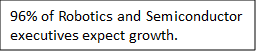
In fact, 96% of the executives and leaders from Robotics and Semiconductors replied either “good”, “very good”, or “excellent.” Nearly half (49%) of those described the outlook as “excellent.” Meanwhile 84% of leaders from Industrial Manufacturing sectors said the same about their projected growth—although far fewer felt “excellent” about their prospects, just 26%.
Employee responses also remained positive, but with less confidence than their leader counterparts. About 83% of talent from Robotics and Semiconductors replied either “good”, “very good”, or “excellent”—13% less than their leaders. However, across Industrial Manufacturing the percentage of similarly confident workers, 89%, outweighed their bosses by 5%.
A key takeaway here is that both groups, executives/leaders and workers, project industry growth and retain an optimistic outlook. The groups begin to differ more distinctly as we look at the major disruptors they expect to impact their industries during the same time period.
Businesses in engineering can leverage this positive forecast by accelerating upskilling initiatives and fostering trust within their teams. Practical steps, such as regular feedback sessions and targeted training programs, will help to bridge any confidence gaps between leadership and staff. By prioritizing these efforts, companies can build a resilient workforce prepared to harness emerging opportunities and respond effectively to industry shifts.
The Future Disruptors that our STEM Experts Anticipate.
Next, we asked both executives and talent to complete the following statement so that it best describes their beliefs: “I anticipate that___________ will cause major disruptions within the next 5 years." See the chart for the key responses provided by our STEM participants.
|
Major Disruptors |
Industrial Manufacturing |
|
Robotics & Semiconductors |
|
|
|
Executives |
Talent |
Executives |
Talent |
|
Increased trade restrictions and regulations |
46% |
35% |
35% |
25% |
|
Decreased trade restrictions and regulations |
11% |
20% |
15% |
17% |
|
Increased use of generative AI to interpret data |
32% |
33% |
49% |
47% |
|
Tariffs |
40% |
29% |
40% |
35% |
|
Shortages of novel raw materials |
25% |
28% |
21% |
29% |
|
Supply chain disruptions |
42% |
32% |
36% |
32% |
|
Industry-wide adoption of quantum computing |
21% |
7% |
19% |
19% |
|
Industry-wide adoption of autonomous systems |
14% |
25% |
26% |
26% |
|
Growing energy demands |
23% |
20% |
33% |
28% |
|
Increased demands for data infrastructure |
26% |
27% |
40% |
38% |
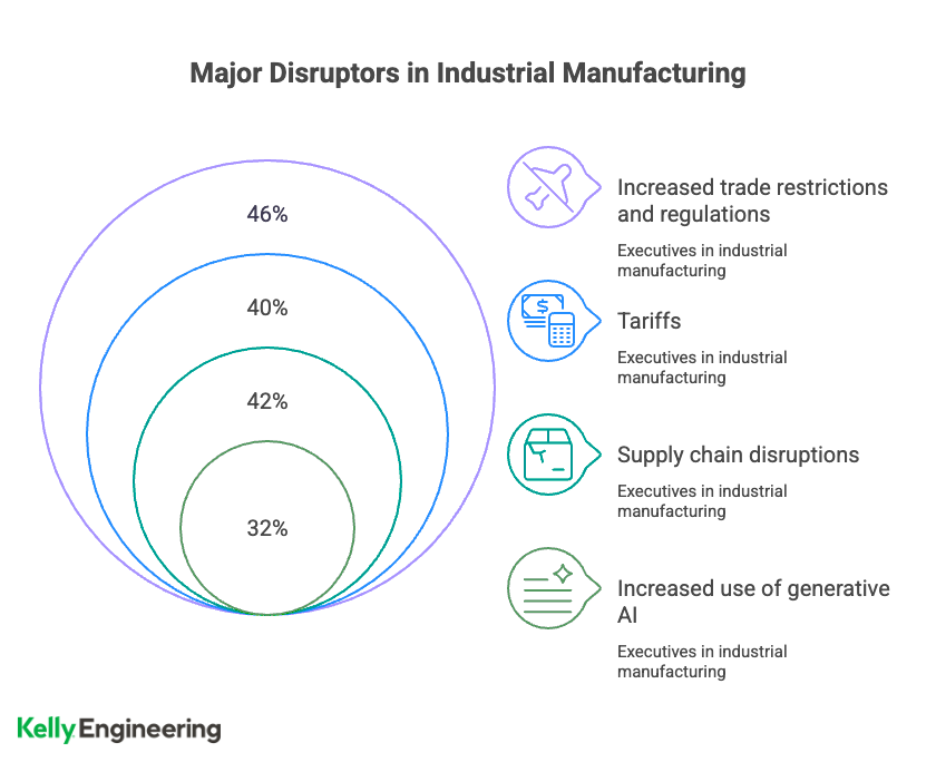
What are the biggest disruptions in Industrial Manufacturing? The top 3 concerns noted by executives and leaders were trade restrictions (46%), supply chain disruptions (42%), and tariffs (40%). Generative Al (32%) is also a key concern. Talent in the sector listed the same top 4, albeit in a different order.
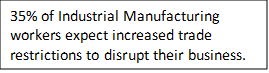
Another key takeaway is that both executives and workers in each industry could agree on several issues that appeared among the top 4 for all groups: the use of generative AI, tariffs, and troubles with the supply chain. However, there’s a disparity of about 10 percentage points between executives and workers in Industrial Manufacturing.
Perhaps as expected, when further comparing the disruptors from executives or leaders to those from talent or employees—the executives focus more on macro-level disruptors like tariffs, regulations, or automation. Meanwhile workers emphasize the more practical and emerging risks. These include Al, energy demands, and material shortages.
Workers or employees in Industrial Manufacturing were most concerned with increased trade restrictions and regulations (35%), followed by increased use of generative AI to interpret data (33%). But they also mentioned supply chain (32%) and tariffs (29%) among their top disruptors. Across Robotics and Semiconductors, both leaders (40%) and employees (38%) were more concerned with increased demands for data infrastructure, such as datacenters or server farms, than with increased trade restrictions and regulations.
But where executives frame disruption as opportunity, workers see risk. The real test is whether leaders can turn confidence into credibility. If optimism is not backed by action, disruption will reshape more than business plans. It will reshape the workforce itself.
Optimism means opportunity. Disruption catalyzes growth.
As the industry braces for major disruptors—from generative AI and increased data infrastructure demands to tariffs and supply chain uncertainties—forward-thinking companies will turn these challenges into advantages. The key lies in viewing disruption not as a threat, but as a catalyst for growth.
Leaders should proactively monitor regulatory changes, technological advancements, and market or engineering workforce trends, while empowering talent to contribute solutions from the ground up. This approach transforms confidence into credibility and ensures that their optimism is matched with strategic action.
To remain competitive, engineering organizations must not only anticipate change but also actively prepare for it. Cultivating an agile mindset, investing in future-facing technology, and reinforcing a culture of continuous improvement will help your business thrive regardless of what the next five years may bring. By focusing on collaboration, upskilling, and adaptability, every member of the workforce can contribute to shaping a dynamic and prosperous future for the industry.
Looking for engineering talent to help navigate change? Learn how Kelly Engineering partners with clients across Robotics, Semiconductors, and Industrial Manufacturing.
The Kelly Re:work 2025 Surveys in Context.
These Kelly Engineering insights were drawn from the broader 2025 Kelly Global Re:work Report, a landmark study on the future of work, based on insights from 6,000+ professionals worldwide. It includes three key surveys:
- Global Workforce Survey – Insights from executives and workers across 13 countries.
- U.S. STEM Survey – Focused on science, technology, engineering, and mathematics sectors.
- Business Professional & Industrial Survey (U.S., Canada, Mexico, Puerto Rico) – Perspectives from business, industrial, and professional talent.
Within Engineering, the report reveals widening gaps between executives and talent on topics such as:
- Economic outlook and industry confidence.
- Adoption of Al and automation.
- Skills gaps and upskilling effectiveness.
- Trust, morale, and DEI commitments.
Engineering Industry Segments and Specialties from our Surveys.
The Engineering specialty spans many core industries that form the backbone of global production and innovation. For our surveys, these sectors fell neatly under two main umbrellas:
|
Industrial Manufacturing
|
Technology Engineering
|
We examine results above from the viewpoint of those two main categories, Industrial Manufacturing and Technology Engineering.

